
Why there’s no honest single number
Search “how long do concrete steps last” and you’ll find confident answers. When we researched this, we couldn’t find a lifespan for concrete steps published by a standards body, a government agency or a concrete industry association. The figures out there come from contractors.
That’s not because concrete steps don’t last. It’s because two sets of steps that look identical on the day they’re finished can age completely differently. One was poured with the right mix, finished and cured properly, and set on a compacted base with real support. The other wasn’t. The calendar doesn’t decide how long steps last; those details do.
What installers say, and how to read it
Some installers publish ranges, and they’re useful as a rough sense of what the trade expects, not as a promise:
| Surface | Installer estimate | Who says so |
|---|---|---|
| Standard pavers (interlock) | 30–40 years | Reliable Hardscapes (GTA installer) |
| Natural stone treads | 50+ years | Reliable Hardscapes |
| Pressure-treated timber | 8–15 years | Reliable Hardscapes |
These are installer estimates, not tested figures, and none is specific to concrete steps. Steps are horizontal, salted every winter and walked on in the same spots, so treat any number as a best case that depends on everything below.
The factors that actually decide it
1. The mix
Front steps are named in CSA A23.1 exposure class C-2: concrete exposed to freeze-thaw and salt. That class calls for at least 32 MPa at 28 days and a water-cement ratio of 0.45 or less, and the Ontario Building Code sets the same minimums for exterior flatwork. A weaker or wetter mix leaves more pores for salty water. The MPa guide explains each number.
2. Entrained air
C-2 concrete needs 5–8 % entrained air: microscopic bubbles that give freezing water room to expand. The NRC lists air-entrained concrete first in its recommendations for severe frost and salt exposure.
3. Finishing
Finishing with bleed water on the surface, overworking it, or steel trowelling an exterior tread weakens the top layer. That layer is exactly what scales off in later winters. A broom or exposed-aggregate finish is standard on exterior steps for grip and durability.
4. Curing
A minimum of 7 days of curing is commonly recommended. Concrete reaches roughly 70 % of its strength in about a week and keeps gaining after that. Steps that dry out too fast in the first days start life with a weaker surface.
5. Base and support
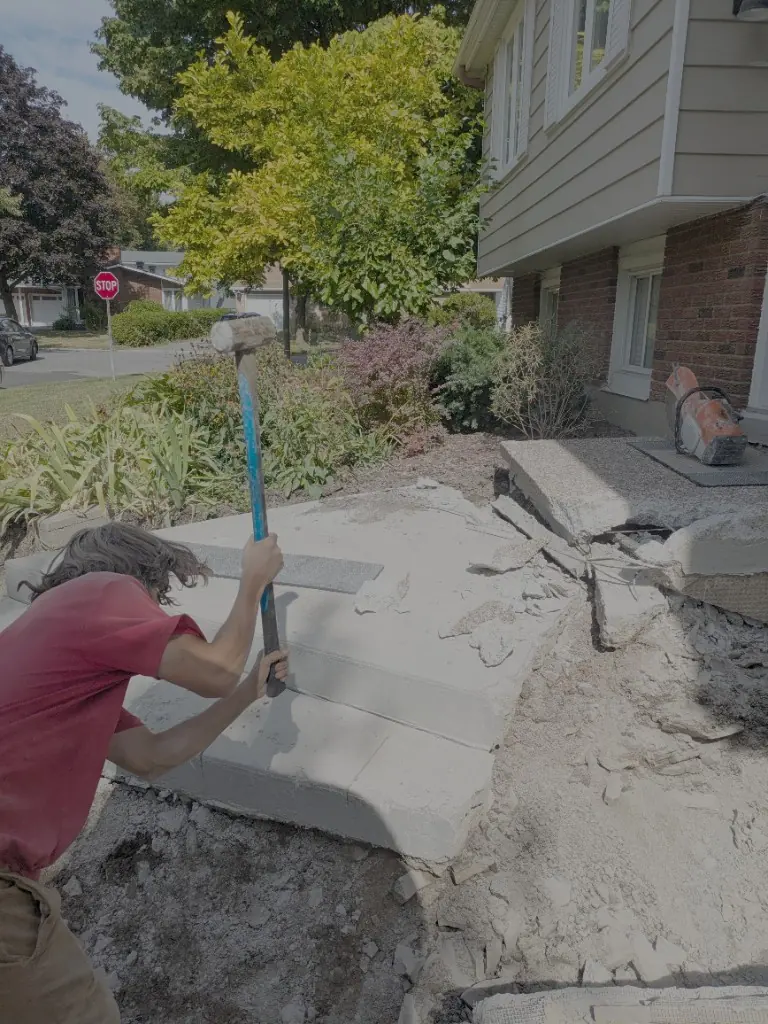
Most failed steps fail from the bottom up. Concrete steps with more than two risers must sit on walls or piers, or be cantilevered from the foundation wall, under the Ontario Building Code (9.8.9.2). Steps set on topsoil or loose fill settle and tilt, and frost makes it worse each winter. Ottawa’s Leda clay can keep settling long after construction, according to NRC research. A perfect mix on a bad base still fails.
6. Drainage
Standing salty water greatly increases scaling. Treads that slope back toward the house, downspouts that empty onto the steps, and snow piles that melt across them all shorten their life.
7. Salt habits
Concrete Ontario says no de-icer of any type in the first winter, and after that, rock salt (sodium chloride) is much less severe than calcium or magnesium chloride. Products with ammonium sulphate, ammonium nitrate or other sulphates or nitrates should never be used. Two identical sets of steps can age very differently depending on what goes on them each winter. See safe de-icers for concrete steps.
8. How old builder steps were built
Steps that came with the house were built to the code and practices of their day, and you usually can’t know what mix or base was used without investigating. Some Code rules for stairs have changed: the minimum tread run went from 210 mm to 255 mm for permits from 2022. Older steps can be perfectly serviceable, but if you replace them, the new steps have to meet current rules.
Factor summary
| Factor | Helps steps last | Shortens their life |
|---|---|---|
| Mix | C-2: 32 MPa, 0.45 w/c | Weaker mix, water added on site |
| Air | 5–8 % entrained | Non-air-entrained concrete |
| Finish | Broom or exposed aggregate, finished promptly | Bleed water worked in; steel trowel outdoors |
| Curing | At least 7 days | Drying out in the first days |
| Support | Compacted base; walls, piers or cantilever over 2 risers | Topsoil, loose fill, no support |
| Drainage | Treads shed water; grade slopes away | Standing water, downspouts onto steps |
| Salt | None first winter; light rock salt after | Calcium or magnesium chloride; fertilizer melts |
| Sealing | Every 1–2 years | Never |
The step-age tool on this page asks a few questions about your steps and points out which of these factors are working for or against them.
Signs your steps are near the end
- a gap opening between the steps and the house, or the steps tilting away
- steps that rock or shift when you walk on them
- widespread scaling exposing stone across the treads
- spalling or crumbling at the nosings and corners
- cracks with one side higher than the other
- water pooling on treads or the landing
Our article on why Ottawa concrete cracks and scales explains what each sign means.
Repair or replace?
Light surface damage on solid, well-supported steps can often be handled with concrete repair or a quartz coating, which needs sound concrete underneath. Movement, settling and widespread deterioration usually point to replacement. Our repair or replace guide walks through the decision, and the concrete steps cost guide covers what each route costs: about $300–$1,500 for repair and resurfacing, compared with $1,800–$4,500 for precast and $2,500–$6,000 for poured replacement.
The short version
No trustworthy source gives a single lifespan for concrete steps, and the installer ranges you’ll see are estimates. What decides it is known: a C-2 mix with entrained air, careful finishing, at least a week of curing, a compacted base with the support the Code requires, good drainage, no salt the first winter and gentle de-icing after, and regular sealing. Get those right and concrete steps can last decades. If yours are showing their age, start with new concrete steps or the repair guide above.
Sources
Every technical claim in this article traces to a published source. We review articles when codes or standards change.
- CSA A23.1 exposure classes (via Atlantic Concrete)
- NRC — Durability of Concrete Under Winter Conditions (CBD-116)
- Concrete Ontario — De-icing Salt Usage
- NRC — Long-term settlements on sensitive clay
- Ontario Building Code 9.8.9.2 — exterior concrete stairs
- Ottawa Masonry — concrete driveway cost (installer page)
- Reliable Hardscapes — interlocking steps cost (installer page)