

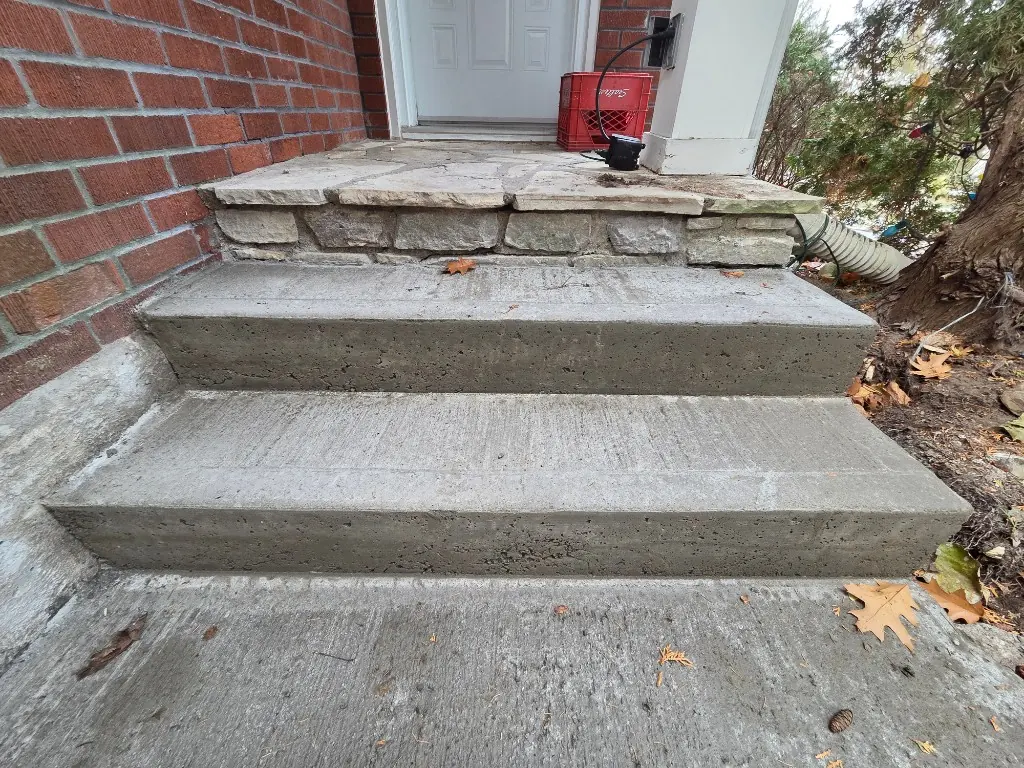
First, find the cause
Concrete damage in Ottawa almost always traces back to one of four things: water, freeze-thaw, de-icing salt and movement. A repair that ignores the cause comes back. So before we quote, we:
- Tap-test treads, risers and edges with a hammer to find hollow, delaminated areas.
- Check for movement — the joint at the foundation wall, the level of the landing, whether the set rocks.
- Look at the water — downspouts, roof drips, landings sloping toward the door, low spots where meltwater sits.
- Look for steel — rust staining or exposed reinforcement.
If the steps are moving or the concrete is delaminated over large areas, we’ll recommend replacement and explain why. If not, here’s what we fix.
Repairs we do
Rebuilt nosings and corners (spalls)
The front edge of each step takes the shovels, the boots and the salt, and it’s where spalling starts. We saw-cut and chip back to sound concrete, pin or reinforce where needed, and rebuild the edge with a repair mortar formed to a crisp, square nosing.
Cracks
Hairline shrinkage cracks are usually cosmetic. Open cracks let water in to freeze. We rout and fill open cracks with a flexible or rigid filler, depending on whether the crack is still moving. Cracks with one side higher than the other point to movement underneath — that’s a base problem, not a filler problem.
Scaling and popouts
Where the top skin has flaked off but the concrete below is sound, the weak surface is ground or chipped away and the step is resurfaced — or finished with a quartz system for a uniform look and better grip.
Rust staining
Early rust staining means water is reaching the steel. We open up the affected area, treat the exposed steel and rebuild the concrete around it, then seal the surface.
Precast reset
A precast set that has settled or tilted but is still sound can often be lifted, re-based and reset on a properly compacted granular base. It usually costs less than a new set and fixes the cause — the base.
After the repair
Repairs need the same care as new concrete: no de-icing salt on fresh repair material for its first winter, sand for traction, and downspouts aimed away from the steps. A penetrating sealer helps keep water and salt out. Concrete Ontario recommends routine sealing of residential flatwork, typically every one to two years, depending on exposure.
What repair costs
Most step repairs run about $300–$1,500. That covers anything from routing and filling a few cracks to rebuilding several nosings or resetting a precast set. Porch resurfacing on a sound slab runs about $2,500–$4,500. We price repairs after the tap-test, because hidden delamination changes the scope.