

A racecourse plan that became a suburb
Barrhaven takes its name from Melville “Mel” Barr, a Kingston contractor who in 1959 bought 200 acres at Greenbank and Fallowfield with a racecourse in mind. He subdivided the land instead, and Old Barrhaven was built through the 1960s and 1970s. Minto built much of the original Barrhaven and Cedargrove through the 1970s and 1980s.
What followed was one of the fastest building runs in the region. Longfields went up mostly in the early 1990s and Davidson Heights through the same decade, while Chapman Mills and Stonebridge, built around a golf course, filled in through the 1990s and 2000s. Between 1988 and 2012, more than 21,000 new houses were built in Barrhaven. South of the Jock River, Half Moon Bay was approved in 1997 and saw its first homes in 2007; by 2021 it alone had 15,219 residents, in homes from builders including Mattamy, Minto, Richcraft, Tamarack and Monarch. Today the community runs from the Greenbelt in the north to the Rideau River in the east and Highway 416 in the west.
Thirty-plus winters on the builder steps
That building history sets the clock for front steps. Old Barrhaven’s 1970s and 1980s homes carry the oldest builder steps in the community, and many have already been replaced at least once. The big 1990s neighbourhoods, Longfields and Davidson Heights, are now past 30 winters on their original sets. Even the earliest Half Moon Bay entrances have seen close to 20.
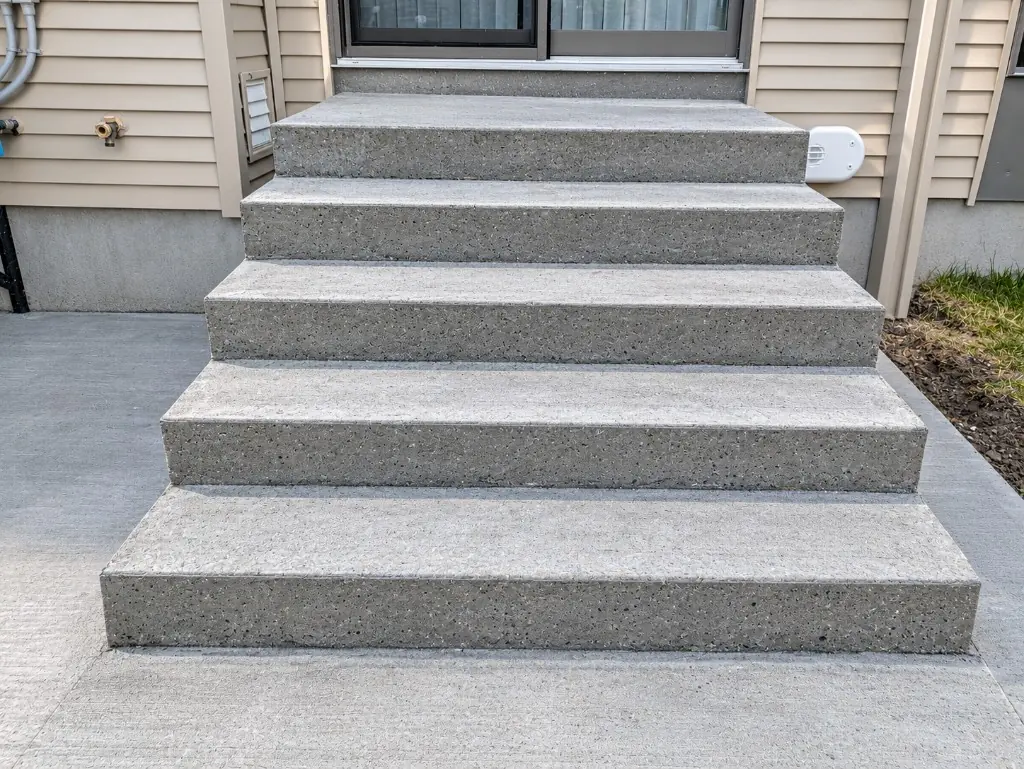
Barrhaven is mostly builder detached homes and townhouse rows, and the entrances follow suit: precast sets with a small landing, often three to five risers on detached homes and a short stoop on townhouses. With so many similar homes built in a short window, wear patterns tend to repeat from street to street. Homes from this period often show:
- Edges worn by salt and shovels. The front nosings scale first, then round over and chip, while the rest of the tread still looks reasonable.
- Steps tipping away from the wall. A thin or poorly compacted base lets a precast set settle. Water gets into the gap, freezes, and pushes it a little wider every winter.
- An uneven joint at the walkway. Where steps meet an interlock or concrete walk, the two can move differently over the years and leave a trip edge at the bottom riser.
Townhouses add a wrinkle. When steps on adjoining units sit side by side, replacing one set means paying attention to how it lines up with the neighbour’s landing, and boom-truck access can be tighter where frontages are short. We check those details at the site visit.
Replace, repair or upgrade
Start with the condition of the concrete itself. If it’s solid and the set is level, concrete repair or a quartz coating can restore a worn surface for much less than a new set. If the steps have moved, the base has failed and replacement is the honest answer. Our repair-or-replace quiz helps you work out which side you’re on.
When it is time for new steps, Barrhaven homeowners usually choose between three paths:
- Like-for-like precast. Builder entrances were sized for standard precast, so a new precast set typically drops into the same footprint. On most Barrhaven streets a boom truck can set it from the driveway in one visit.
- Poured concrete for a better entrance. If the original landing is too shallow for the door, or you want wider steps or a different direction, poured steps are formed to fit. A covered front porch can be poured with them in the same project.
- Interlock or composite. If the driveway and walkway are interlock, interlock steps can match them. For side doors and back entrances, wood and composite steps are often simpler.
If your new set has more than three risers, it needs a handrail, and any landing more than 600 mm above the ground beside it needs a guard. Our railings are sized to the Ontario Building Code’s 865–1,070 mm handrail range.
Concrete made for Ottawa winters
Poured steps should meet CSA exposure class C-2: a minimum of 32 MPa at 28 days, 5–8 % entrained air and a water-cement ratio of 0.45 or less. That’s what we order. Below the steps, the Ontario Building Code allows one- or two-riser concrete steps to sit on grade, but taller sets need proper support — walls, piers or a cantilever from the foundation under 9.8.9.2 — and foundation depth per 9.12.2.2. Parts of Ottawa sit on Leda clay, which can keep settling long after construction, so we excavate and compact a granular base under every set.
Fresh concrete is most vulnerable in its first winter. Use no de-icing salt on it that season, and keep the plough’s salty spray off where you can. The first-winter care guide has the rest.
Barrhaven neighbourhoods we serve
We work throughout Barrhaven — Old Barrhaven, Cedargrove, Longfields, Davidson Heights, Chapman Mills, Stonebridge and Half Moon Bay — and nearby in Riverside South, Manotick and Richmond. Our in-house crew takes care of removal, base, steps and railings. Take the repair-or-replace quiz, price a set in the estimator, or book a free site visit below.