
Quartz finish

Quartz coating for steps, porches and garage floors

A quartz system turns tired, scaled-looking concrete into a deep charcoal, grey or tan surface with real grip — built in layers, sealed with a UV-stable topcoat, and only installed over concrete that's sound enough to deserve it.

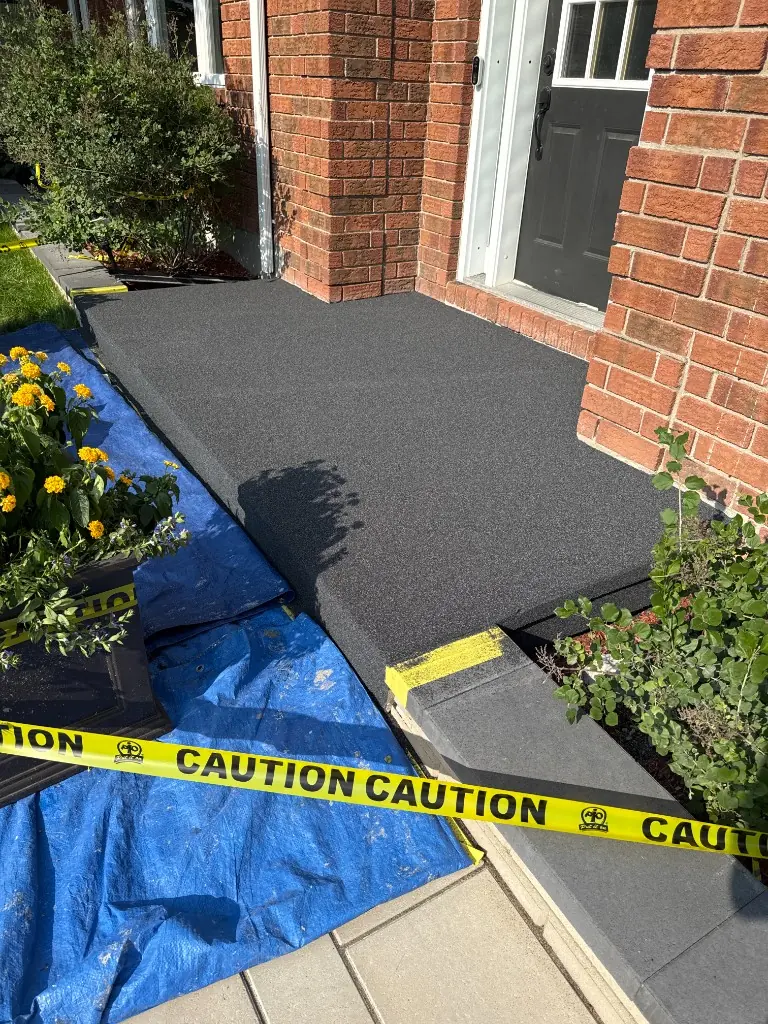
Front porch and step finished with a charcoal quartz coating, taped off while it cures
Charcoal quartz porch, curing
Steps & porches
$15–$25 / sq ft
Garage floors
$8–$15 / sq ft
Layers
7-step system
Topcoat
UV-stable

What a quartz system is

A quartz finish isn’t paint, and it isn’t a single coat of epoxy. It’s a built-up system: the concrete is ground open, primed, coated with a pigmented resin, and then coloured quartz granules are thrown into the wet coat until it can’t hold any more — “broadcast to refusal.” A grout coat locks the quartz in place, and a clear UV-stable topcoat seals it all.

The result is a dense, textured, speckled surface. It hides the blotchy look of weathered concrete, adds grip, and is easy to sweep and hose off. In charcoal it gives a front entrance a sharp, modern look. In greys and tans it can quietly match brick, stone or siding.

Where we use it

  • Front steps and landings that are structurally sound but scaled, pitted or blotchy
  • Porches — including the joint between porch and steps, for one continuous surface
  • Garage floors — where salty slush and hot tires are the enemy (see garage floors)
  • Over fresh repairs, so rebuilt edges and patched areas disappear under one uniform finish

Why outdoor quartz needs a different topcoat

The most common reason outdoor coatings fail early is the wrong topcoat. Standard aromatic epoxy yellows and chalks in sunlight. Ottawa installers report it happening within a year or two in direct sun. Exterior systems need a polyaspartic or aliphatic polyurethane topcoat — chemistries designed to stay clear under UV.

The second most common reason is the concrete underneath. A coating mirrors what it’s stuck to. No coating can make unsound concrete structurally sound, or stop water coming through failed drainage or active cracks. That’s why every quartz job starts with a tap-test and a moisture and drainage check, and why we’ll sometimes say “repair first” or “replace instead.”

The system, layer by layer

The diagram below shows the seven layers. In order:

  1. Inspect and test — tap for hollow spots, check drainage and moisture.
  2. Diamond-grind to the profile the coating maker specifies — diamond grinding gives about CSP 2, and some quartz systems call for CSP 3–4 — so the system bonds mechanically.
  3. Repair — rout and fill cracks, rebuild spalled nosings, patch pits.
  4. Epoxy primer soaks into the ground concrete.
  5. Pigmented body coat sets the colour depth.
  6. Quartz broadcast to refusal — one or two broadcasts depending on the build.
  7. Grout coat locks the quartz in.
  8. UV-stable topcoat for colour stability, stain resistance and the final texture.

Colour families

Quartz comes in blends rather than flat colours. We work with generic colour families — charcoal, graphite and silver greys, tans and sands, salt-and-pepper, and charcoal-tan blends — and bring real samples to the site visit so you see them in daylight against your house. Explore the families below.

Weather and timing

Exterior quartz is a warm, dry-season job in Ottawa. The concrete must be dry, and air and surface temperatures must be within the products’ limits for the primer, body coat and topcoat to cure properly. We schedule exterior quartz work from late spring to early fall and confirm product temperature limits for each job.

Pricing

On steps and porches, quartz runs about $15–$25 per sq ft of treads, risers and landing. Small step jobs have a minimum charge, because grinding, edge detailing and the multi-coat schedule take the same setup regardless of size. Garage floor systems run about $8–$15 per sq ft. Repairs needed before coating are quoted separately — usually within $300–$1,500 for steps. Use the estimator and choose “Quartz resurface” for a ballpark on your entrance.

The system

Seven layers, one finish

A quartz finish is built up in layers. Skip one and it fails early — usually the surface preparation or the topcoat.

  1. 01
    Profiled concrete

    The old surface is mechanically profiled to the coating maker's specified roughness (ICRI CSP scale; some quartz systems call for CSP 3–4) after checking for moisture and hollow spots. No grinding, no bond.

  2. 02
    Crack & spall repair

    Cracks are routed and filled, chipped edges rebuilt. Coatings mirror what's under them, so repairs happen first.

  3. 03
    Penetrating primer

    Soaks into the open pores of the ground concrete to anchor everything above it.

  4. 04
    Pigmented body coat

    A tinted, UV-stable resin layer that the quartz sinks into. It gives the system its thickness and colour depth.

  5. 05
    Quartz broadcast

    Coloured quartz granules thrown into the wet body coat until it can't hold any more ("to refusal"). Some systems do it twice for extra build.

  6. 06
    Grout coat

    A clear coat that locks the quartz in place and fills the gaps between granules, so the surface is textured but easy to sweep.

  7. 07
    UV-stable topcoat

    A clear polyaspartic or aliphatic polyurethane top layer. It's what keeps an outdoor quartz finish from yellowing in the sun, and it sets the final grip.

FAQ

Quartz coating: common questions

Is quartz coating good for outdoor steps in Ottawa?

Yes, when it's the right system on the right concrete. Outdoor quartz needs a UV-stable topcoat — plain epoxy yellows and chalks in sunlight — and it has to go over concrete that is sound, dry and not moving. On those terms, a quartz finish adds grip, colour and an easy-to-clean surface.

Why not just use epoxy?

Standard aromatic epoxy yellows and chalks under UV light. Ottawa installers report visible yellowing within 12 to 18 months in sunlight. Outdoor systems use a polyaspartic or aliphatic polyurethane topcoat, which is designed to stay clear in the sun.

Is quartz slippery when wet or icy?

The quartz broadcast and a textured topcoat give grip, and quartz systems are known for slip resistance. But no surface is slip-proof on ice or wet snow — traction still depends on conditions and footwear. Very aggressive texture also makes sweeping and shovelling harder, so we balance grip and cleanability.

Can quartz go over crumbling steps?

Not over concrete that's delaminated, moving or structurally cracked. No coating can make unsound concrete sound — it just fails along with it. Light scaling, popouts, crazing and repaired edges on otherwise sound steps are fine once ground and repaired. The repair-or-replace quiz is a good first check.

How long before I can walk on it?

Polyaspartic topcoats typically take light foot traffic within hours to a day, and full cure takes a few days. Garage floors with vehicles take longer. We give you exact times based on the products and the weather.

Can I use salt on a quartz finish?

The sealed surface keeps water and salt out of the concrete below, but we still recommend plain rock salt over harsher calcium or magnesium chloride products, and shovelling with a plastic blade.

Free quote · Ottawa & area

Let’s talk about your front steps.

Tell us what your entrance looks like today. We visit, measure and give you a clear written quote — no pressure, no surprises.

Get your free step quote

We reply within one business day. No spam, no sharing your details.

Capital Steps · Step guide

Ask or search

Answers come only from our verified knowledge bank — sourced from CSA A23.1, the Ontario Building Code, the City of Ottawa and Ottawa market research. If we don't have a verified answer, we'll say so.

Popular questions