
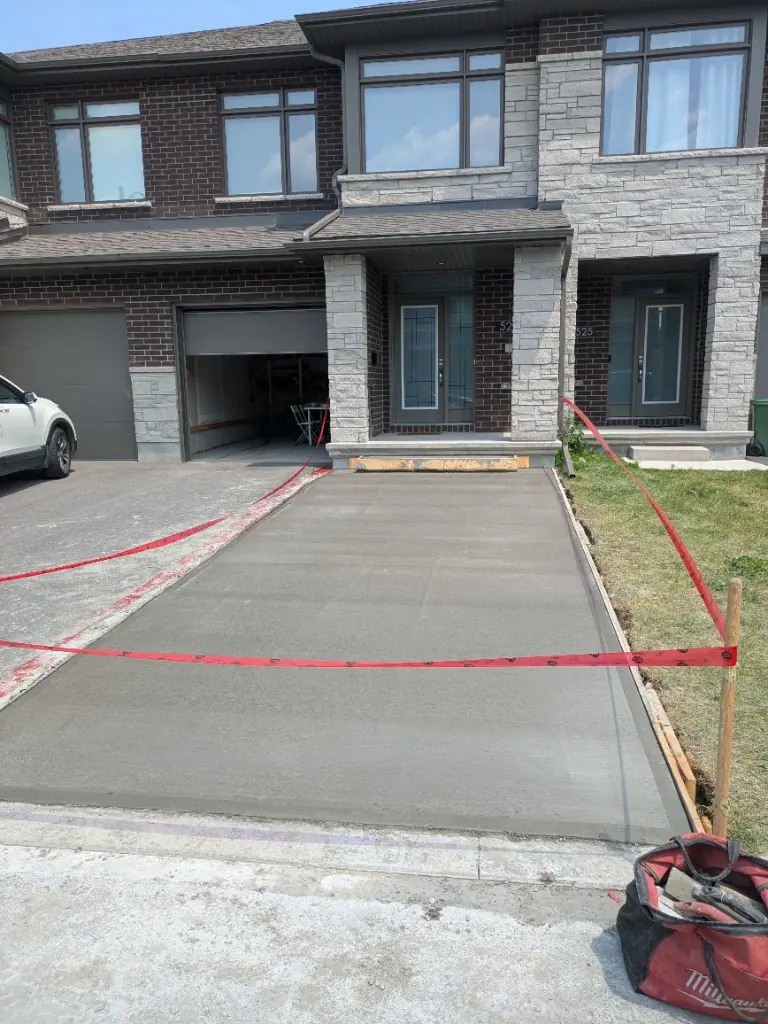
A driveway is a front step laid flat
Your driveway gets the same meltwater, freeze-thaw cycles and de-icing salt as your front steps. On top of that, it carries the weight of a car and the salty slush that drips off it. Concrete Saskatchewan notes that salt carried on cars can scale new driveways, and that standing salty water makes scaling much worse. So we pour driveways to the same standard as concrete steps.
The mix: class C-2, the same as your steps
| Requirement | Driveway spec | Reference |
|---|---|---|
| Strength at 28 days | 32 MPa minimum | OBC 9.3.1.6, CSA class C-2 |
| Entrained air | 5–8 % | OBC 9.3.1.6(2), CSA air category 1 |
| Water-cement ratio | 0.45 maximum | OBC 9.3.1.7, CSA class C-2 |
| Slab thickness and base | Not set by the code | Ask for both in writing |
Twenty-eight days is the age at which strength is tested, not the day the concrete is “done”. The MPa guide explains each figure.
The base: where Ottawa driveways succeed or fail
Because the code leaves thickness and base to the contractor, this is where quotes differ most. Ottawa paving guidance calls for about 8–12 in of excavation, a geotextile over Leda clay where it’s present, and a Granular B subbase topped with Granular A, mechanically compacted. Ottawa concrete cost breakdowns describe a 4–8 in compacted crushed-stone sub-base under a 4–5 in slab reinforced with wire mesh, fibre or a 10M rebar grid.
Ottawa’s marine clays can keep settling for years and shrink as they dry, so we remove soft material, compact in layers and tell you the base depth and slab thickness in writing. The slab is graded to shed water away from the house. City rules don’t allow you to change your property’s approved drainage pattern or send water onto a neighbour.
Joints that put the cracks where you want them
Concrete shrinks as it cures and moves with temperature, so it will crack somewhere. Control joints decide where:
- Space joints 24 to 36 times the slab thickness, to a maximum of about 4.5 m. A 100 mm (4 in) slab gets joints about every 3 m.
- Keep panels square or close to it, no more than 1.5 times as long as they are wide, and avoid L-shaped panels.
- Cut joints at least a quarter of the slab depth, with saw cuts usually made 4–12 hours after finishing.
- Use isolation joints where the driveway meets the garage slab, the foundation and the steps.
Finishes
A broom finish is the standard because it grips in wet and icy weather. Exposed aggregate adds about $3–$5 per sq ft and hides wear well. Stamped concrete runs about $18–$45 per sq ft. We don’t steel-trowel exterior slabs. The NRC notes that hard trowelling and finishing with bleed water on the surface weaken resistance to frost and salt.
Curing, the first winter and sealing
At least seven days of curing is the common recommendation, and concrete reaches roughly 70 % of its strength in that time. Keep vehicles off for at least 7 days, according to Concrete Ontario’s driveway guidance as summarised by Ottawa Concrete Pros. Seal only after at least 30 days of air drying, then reseal typically every 1–2 years.
For the first winter, use no de-icer of any kind, only sand. After that, light rock salt is the gentlest option. Never use fertilizers containing ammonium sulphate or nitrate. See first-winter care and why Ottawa concrete scales.
Permits, the right of way and licensing
- Part of most Ottawa front yards is City right of way, and it may be wider than you think.
- Under Access By-law 2026-139, an access permit is required to build, modify (including widening), close or remove a vehicular access. The 2026 fee is $208, and the process takes about 6–8 weeks, including the contractor’s road cut permit.
- Resurfacing an access without changing its location, dimensions or grading needs no access permit.
- A vehicular access must be 2.4–9 m wide. In the right of way, the driveway and walkway together can cover no more than 50 % of the frontage.
- A separate pedestrian access up to 1.8 m wide needs no permit if it meets the by-law’s criteria, including sitting at least 1.8 m from the driveway.
- The City requires hardscaping contractors who build driveways to be licensed. Ask any contractor you’re considering for their City hardscaping licence and a written contract.
What a concrete driveway costs
A broom-finished driveway runs about $10–$20 per sq ft in Ottawa. Removing the old slab adds about $3–$5 per sq ft. See the concrete cost guide for the full breakdown and our process for how a job runs.