

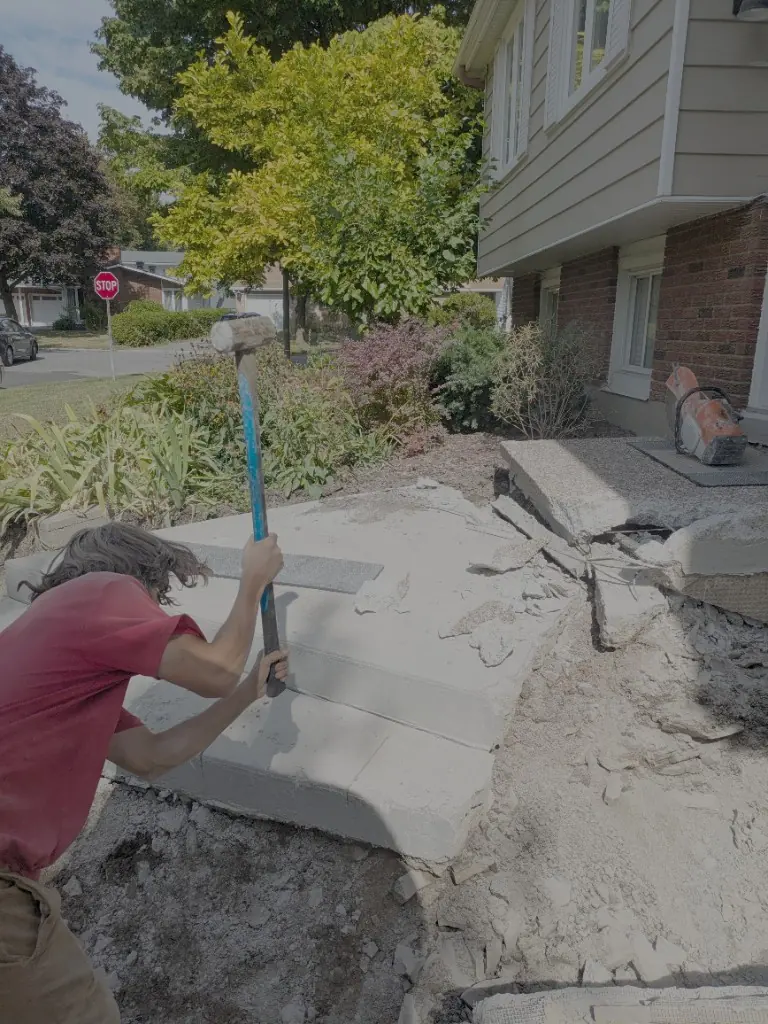
What freeze-thaw does inside concrete
Concrete looks solid, but it is full of tiny pores. In an Ottawa winter, meltwater soaks into those pores, freezes, expands and thaws again, over and over. Each freeze pushes outward on the paste around it.
Good exterior concrete is built for this. Air-entrained concrete contains microscopic air voids, mixed in on purpose, that act as pressure relief when the water in the pores freezes. Exterior flatwork in Ontario needs 5–8 % entrained air for exactly this reason (see the MPa guide).
The weak point is saturation. If the voids themselves fill with water, they can no longer relieve pressure. Concrete Ontario points out that at an early age those voids can still be saturated, which is why young concrete is especially vulnerable in its first winter.
Why salt makes it worse
The National Research Council’s Canadian Building Digest 116 is blunt: surface scaling “occurs mainly on pavements, sidewalks and other horizontal surfaces, and is most severe if de-icing salts have been used.” It can reach depths of an inch or more, and it is progressive: once it starts, each winter takes a little more.
That is why front steps are hit so hard. They are horizontal, they are salted more than almost any other surface at the house, and the treads hold meltwater right where people walk.
Scaling, spalling and popouts: telling them apart
Not every damaged surface has the same problem. The damage dictionary on this page describes each type in detail; here’s the short guide.
| Damage | What it looks like | Usual story |
|---|---|---|
| Scaling | Thin flakes of surface mortar peeling off, often over large areas of a tread or slab, exposing stone | Freeze-thaw plus salt attacking a surface layer that was weak, wet or too young |
| Spalling | Deeper pieces breaking away, often at edges, corners and nosings | Damage reaching below the surface; worth having assessed before choosing a repair |
| Popouts | Small, cone-shaped pits where a piece of surface has broken out above a particle near the surface | Usually small and local; many popouts across a surface are worth having looked at |
| Cracks | Lines through the concrete, sometimes with one side higher than the other | Shrinkage between joints, or movement in the base underneath |
Light scaling on otherwise solid, well-supported steps is often a candidate for concrete repair. Widespread spalling or movement usually points the other way. Our repair or replace guide helps you decide.
De-icer chemistry: not all salt is equal
Concrete Ontario’s guidance on de-icers is clear:
- All de-icing salts can cause distress over time.
- Sodium chloride (rock salt) is much less severe than the alternatives. It is effective to about −10 °C.
- Calcium chloride and magnesium chloride are more aggressive toward concrete.
- Never use products containing ammonium sulphate, ammonium nitrate, or other sulphates or nitrates, which are common in fertilizers. They are chemically aggressive to concrete.
- New concrete should get no de-icer of any type in its first winter; use sand for traction.
Read the label on any “ice melt” before you buy it. The full guide is which de-icers are safe on concrete steps.
Drainage: where water sits, damage follows
Concrete Saskatchewan’s technical guidance notes that poor drainage, which lets salty water stand on the surface, greatly increases scaling. Treads that slope back toward the house, low spots on a landing, and downspouts emptying onto a walkway all keep the surface wet and salty for longer. Salt carried on cars can also scale new driveways and garage slabs.
For steps, the fix starts at design: a slight pitch on each tread, and grading that carries water away. Keep in mind that the City doesn’t allow homeowners to change a property’s grading in ways that send water onto neighbours.
Finishing and curing mistakes that show up years later
Many scaling problems are built in on the day of the pour:
- Finishing with bleed water on the surface. Overworking the surface, or finishing while water is present, weakens the top layer. Screeding should be followed promptly by bull floating.
- Steel trowelling exterior treads. The NRC advises against steel trowelling exterior horizontal surfaces in severe frost and salt exposure.
- Extra water in the mix. Exterior concrete is capped at a 0.45 water-cement ratio. Water added on site to make placing easier raises it.
- Short curing. A minimum of 7 days of curing is commonly recommended.
- Salt too soon. The NRC recommends air-drying after curing before salt exposure, and Concrete Ontario recommends at least a 30-day air-drying period for concrete placed in cool weather.
Our article on how concrete is poured shows where each of these stages happens.
Cracks that start below: settlement, frost and Leda clay
Surface damage comes from above. Cracks that tilt, widen or come with steps pulling away from the house usually start below.
Much of Ottawa sits on Leda clay (Champlain Sea marine clay). NRC research shows these sensitive clays can keep settling long after construction, and that drying from tree roots or lower groundwater causes shrinkage settlement of shallow foundations. An NRC study of older Ottawa houses on Leda clay found differential movements of up to about 355 mm (14 in), greatest near mature trees.
Frost adds to it. Frost-susceptible soils heave when they freeze. A step set on topsoil or loose fill, with water collecting under it, gets nudged a little further out of line every winter.
That’s why the Ontario Building Code requires exterior concrete stairs with more than two risers to sit on concrete or masonry walls or piers, or be cantilevered from the foundation wall with proper anchorage (OBC 9.8.9.2 and 9.8.10). Steps with one or two risers may be laid on the ground. The building code guide covers the details.
Control joints: planned cracks
Concrete shrinks as it dries, and some cracking is expected. Control joints decide where it happens. Industry guidance calls for joints every 24 to 36 times the slab thickness, to a maximum of about 4.5 m, cut at least a quarter of the way through. A crack running neatly along a joint is the joint doing its job. A crack wandering across a panel with no joint nearby suggests the joints were too far apart, too shallow or cut too late.
What you can do now
- Switch to plain rock salt, used sparingly, or sand.
- Clear snow before it melts and soaks in.
- Fix downspouts and low spots that keep the steps wet.
- Seal residential flatwork every 1–2 years, as Concrete Ontario recommends.
- Have movement or widespread spalling assessed before choosing a cosmetic fix. A quartz coating needs sound concrete underneath; it won’t stop movement.
The short version
Ottawa concrete breaks down when water, freezing and salt meet a surface or base that wasn’t built for them. Scaling comes from freeze-thaw and de-icers acting on a weak, wet or young surface. Cracks and tilting come from settlement and frost below, which Leda clay makes worse. The defences are a C-2 mix with entrained air, careful finishing and curing, no salt in the first winter, gentle de-icers after that, good drainage, and a proper base and support. If your steps are already showing damage, start with step repair or new concrete steps.
Sources
Every technical claim in this article traces to a published source. We review articles when codes or standards change.
- NRC — Durability of Concrete Under Winter Conditions (CBD-116)
- Concrete Ontario — De-icing Salt Usage
- Concrete Saskatchewan — Tech Tip: Scaling
- NRC — Long-term settlements on sensitive clay
- NRC — House settlements and trees
- Ontario Building Code 9.8.9.2 — exterior concrete stairs
- NRMCA CIP 6 — Joints in Concrete Slabs on Grade