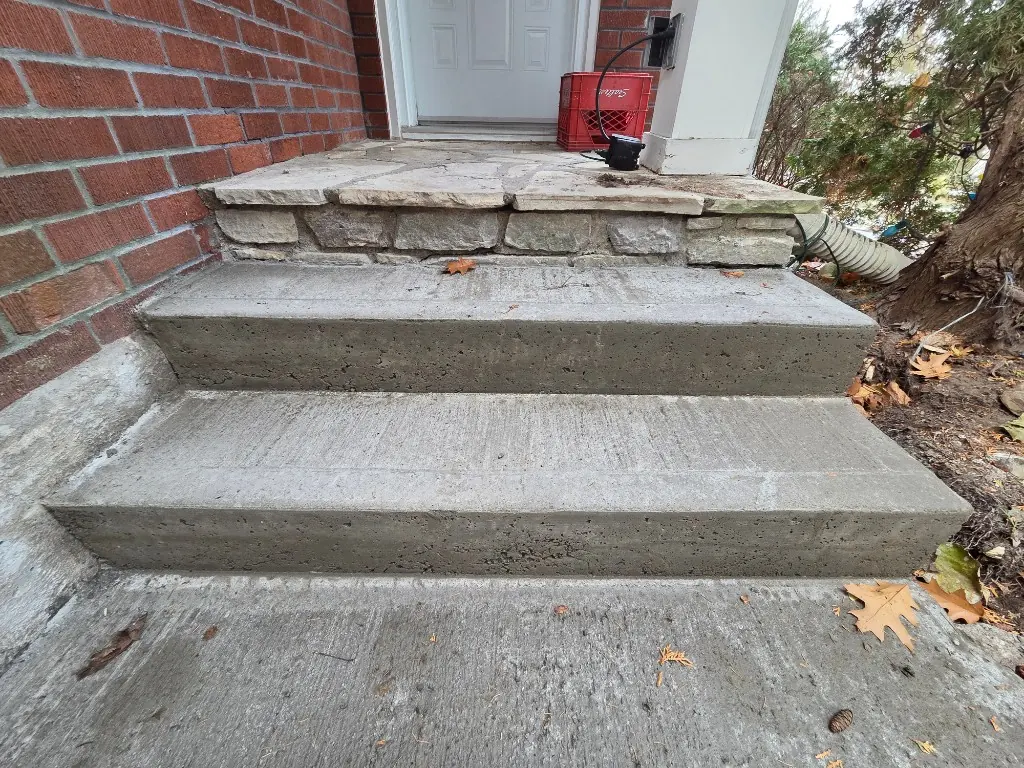
Why de-icers damage concrete
Concrete is porous. In winter, meltwater soaks into those pores, freezes and expands. Exterior concrete in Ottawa is made with 5–8 % entrained air, microscopic bubbles that give that expanding ice somewhere to go. That’s what lets good concrete survive freeze-thaw at all.
De-icers change the picture. The National Research Council’s Canadian Building Digest 116 says surface scaling “occurs mainly on pavements, sidewalks and other horizontal surfaces, and is most severe if de-icing salts have been used.” Concrete Ontario defines scaling as the loss of surface mortar, seen as flaking or peeling. On steps, that’s the treads and nosings, exactly where people walk.
So the question isn’t whether a de-icer melts ice. It’s how much it costs the concrete to do it. Our article on why Ottawa concrete cracks and scales covers the science in more depth.
The de-icers, compared
| Product | Effect on concrete (per Concrete Ontario) | Use on steps |
|---|---|---|
| Sand or grit | No chemical effect; traction only | Any time, including the first winter |
| Sodium chloride (rock salt) | Can cause distress over time, but much less severe than the alternatives; effective to about −10 °C | Light-to-moderate use, after the first winter |
| Calcium chloride | Much more severe than rock salt | Avoid on concrete |
| Magnesium chloride | Much more severe than rock salt | Avoid on concrete |
| Ammonium sulphate / ammonium nitrate | Chemically aggressive | Never |
| Fertilizer-based melts (sulphates, nitrates) | Chemically aggressive | Never |
| Any de-icer on new concrete | Saturated young concrete is especially vulnerable | Never in the first winter |
Rock salt: the gentlest of the salts
Concrete Ontario is clear that all de-icing salts can cause distress over time. But sodium chloride, ordinary rock salt, is much less severe than calcium chloride or magnesium chloride. It works down to about −10 °C. Colder than that, it does little, and adding more just leaves more salt on the concrete. Switch to sand on the coldest days.
After the first winter, Concrete Ontario says light-to-moderate rock salt may be used if needed. “If needed” is the key phrase. Spread a thin scatter after shovelling, not a heavy layer before.
Calcium and magnesium chloride: more aggressive
Many “ice melt” blends sold in hardware stores are based on calcium chloride or magnesium chloride, sometimes mixed with rock salt. Concrete Ontario says both are much more severe on concrete than sodium chloride. Check the ingredient list before you buy, not just the claims on the front of the bag.
Never: ammonium, sulphates, nitrates and fertilizer
Concrete Ontario, Concrete Saskatchewan and Concrete Alberta all warn against de-icers containing ammonium sulphate, ammonium nitrate, or other sulphates or nitrates. These chemicals are common in fertilizers, and they attack concrete chemically, not just through freeze-thaw. Don’t use garden fertilizer as an ice melt, and avoid any product that lists these ingredients.
Sand and grit: traction without the damage
Sand doesn’t melt anything, but on a step, grip is what keeps people safe. It’s the only option Concrete Ontario recommends for new concrete in its first winter, and it’s the best option on any day colder than about −10 °C. Keep a pail by the front door, spread a thin layer after clearing, and sweep it up in spring so it doesn’t grind into the surface.
Clear snow before it melts in
Concrete Ontario’s advice is to clear snow and ice before meltwater soaks in. Every centimetre you shovel off is snow that won’t melt into the concrete, refreeze overnight and need salt in the morning. Shovel early, shovel often, and use a plastic or rubber-edged shovel so you don’t gouge the surface.
The first winter: none at all
For new concrete, the rule is simple: no de-icer of any type in its first winter. At an early age the air voids can still be saturated, so they can’t relieve freezing pressure, and salt turns that into scaling. Concrete Ontario also recommends at least 30 days of air drying after curing before concrete placed in cool weather sees salt. The full guide is first-winter care for new concrete.
Drainage: where salt water sits, damage follows
Concrete Saskatchewan notes that poor drainage, which lets salty water stand on the surface, greatly increases scaling. Watch for:
- treads or landings that hold puddles
- downspouts that empty onto steps or walkways
- snow piles that melt across the concrete
- salty slush dropped by cars on a driveway or garage floor
Fixing these does more for your steps than switching brands of salt.
Sealing
Concrete Ontario recommends routine sealing of residential flatwork, typically every 1–2 years depending on exposure and product, and especially where de-icing salts are used. New concrete should air-dry for at least 30 days before sealing. A sealer helps, but it doesn’t make calcium chloride or fertilizer melts safe.
Other materials at the front door
- Interlock: pavers made to the Canadian standard (CSA A231.2) are tested for de-icing salt freeze-thaw resistance. The same drainage and clearing habits still help. See interlock steps.
- Wood and composite: composite’s non-porous surface can hold meltwater that refreezes, so drainage slope and traction matter in winter. See wood steps.
- Aluminum railings: aluminum doesn’t rust, but it can pit in road-salt exposure. Touch up chipped powder coat, and rinse salt off, especially in spring. See railings.
The short version
Use sand for grip whenever you can, and always in the first winter. After that, light rock salt is the gentlest salt for concrete and works to about −10 °C. Avoid calcium and magnesium chloride, and never use products with ammonium, sulphates or nitrates, including fertilizer. Clear snow before it melts in, fix drainage, and seal every 1–2 years. If salt has already taken its toll, read about concrete repair or new concrete steps.
Printable
First-winter care card


First-winter care card for new concrete
New concrete keeps gaining strength for weeks after the pour. These habits protect it through its first Ottawa winter.
- No de-icing salt of any kind on new concrete for its first winter — use clean sand or a non-chloride traction grit instead.
- Watch for salt you don't spread yourself: city ploughs, snow from the road, and slush dripping off cars all carry it.
- Shovel with a plastic blade, not a steel edge or ice chipper.
- Don't pile snow from the driveway or road onto new steps and walkways.
- Keep downspouts and roof drips aimed away from the steps so water doesn't pool and refreeze.
- If the concrete was poured in summer or early fall, ask about a penetrating sealer before the first freeze.
- After the first winter, re-seal on the schedule your installer recommends.
Questions about your new concrete? Call 343-997-9955.
Sources
Every technical claim in this article traces to a published source. We review articles when codes or standards change.